
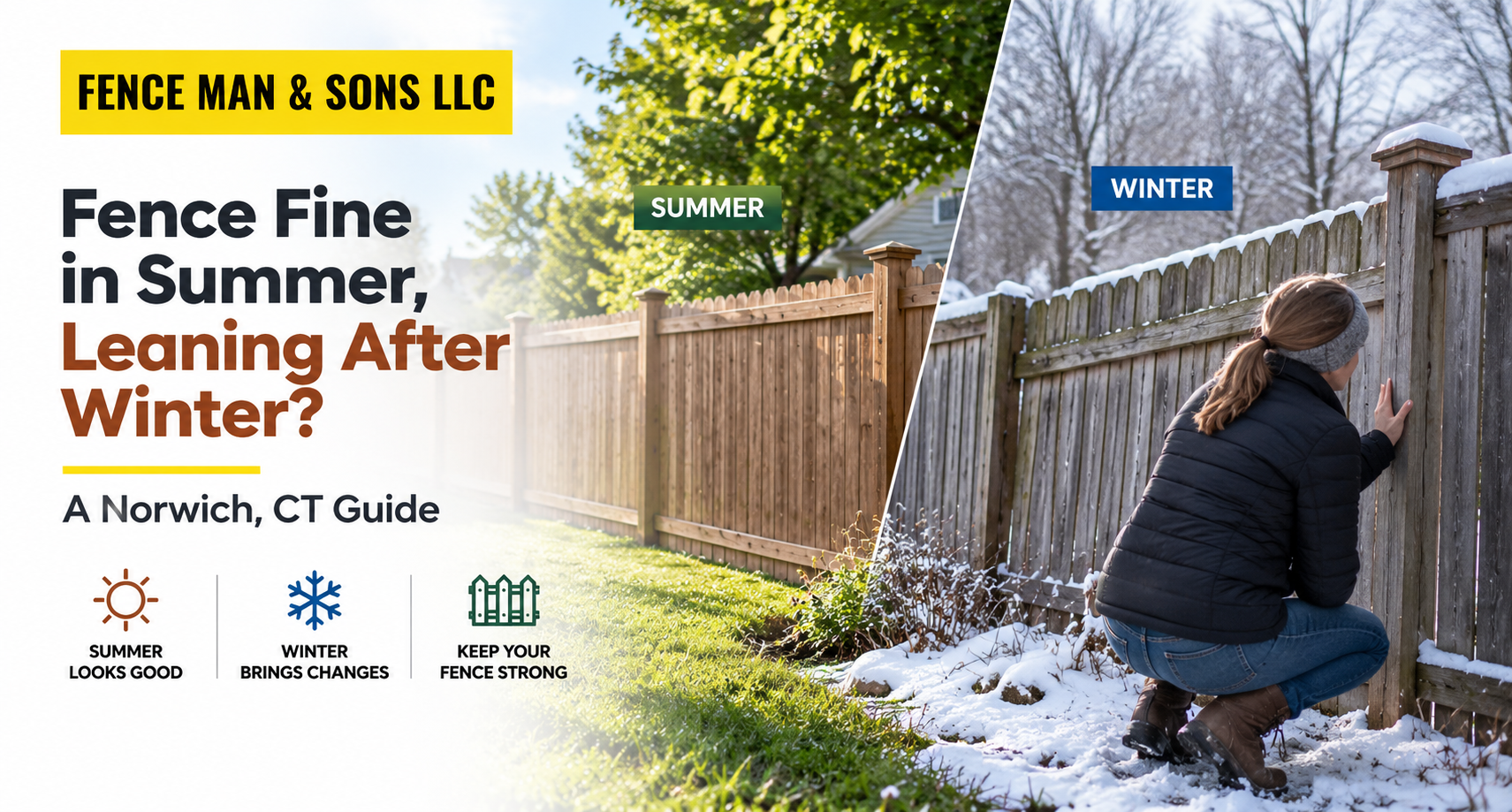
A fence that looked perfectly straight during summer can sometimes look very different after a Connecticut winter. You may notice a post leaning slightly, a gate that no longer closes smoothly, or an entire section that seems out of alignment. It can be confusing, especially when the fence did not show any obvious problems a few months earlier.
Winter weather can be hard on outdoor structures. Cold temperatures, frozen ground, snow, moisture, and repeated freeze-thaw cycles can all affect the soil supporting fence posts. Understanding why these changes happen can help Norwich homeowners recognize problems early and decide whether a fence needs monitoring, repair, or professional evaluation.
Why Can a Fence Move During Winter?
A fence depends heavily on the stability of its posts. Even a strong fence material will have trouble staying straight if the ground supporting those posts moves.
During colder weather, moisture in the soil can freeze. As conditions change and the ground thaws again, the soil around a post may shift. Drainage, soil type, post installation, and the condition of the surrounding ground can all influence how much movement occurs.
This is why homeowners may first notice a leaning fence in late winter or early spring rather than during summer.
The Fence Material Is Only Part of the Story
Homeowners often focus on whether wood, vinyl, aluminum, or chain link is the most durable option. Material certainly matters, but it is not the only factor affecting long-term fence performance.
Post depth, spacing, hardware, gate design, ground conditions, drainage, and installation quality all contribute to how well a fence handles seasonal changes.
Fence Man and Sons LLC offers several residential fencing options, including vinyl, wood, chain link, ornamental aluminum, privacy, pet, and pool fencing. Whatever material is selected, it still needs to be properly suited to the property and installed with local conditions in mind.
Is a Slight Lean Always a Serious Problem?
Not necessarily. A small amount of movement does not automatically mean the entire fence needs replacement.
The important question is whether the movement is stable or getting worse. Look along the fence line from a distance. Is one post slightly out of position, or are several posts leaning in the same direction? Has the fence panel started separating from a post? Has the top line of the fence become noticeably uneven?
Taking a few photos can also help homeowners compare the condition over time instead of relying on memory.
Pay Attention to the Gate
The gate is often one of the first places where fence movement becomes noticeable.
A gate depends on accurate alignment between its posts, hinges, and latch. If one supporting post shifts even slightly, the gate may begin dragging, sticking, or failing to latch properly.
Homeowners sometimes try to solve this by adjusting the latch. That may help temporarily, but if the supporting post continues to move, the alignment problem can return.
A gate that suddenly behaves differently after winter can therefore be a useful sign that the surrounding fence structure deserves a closer look.
Snow and Moisture Can Add Extra Stress
Winter problems are not limited to frozen soil. Heavy snow can place pressure against fence panels, especially when snow is repeatedly piled in the same area.
Melting snow also introduces additional moisture around fence posts. If drainage is poor, some sections of the property may stay wetter than others.
For homeowners comparing durable fencing options for cold climate in Norwich, CT, it is useful to think beyond the fence material itself. How water moves across the property and where snow accumulates can also influence long-term performance.
Should You Straighten a Leaning Fence Yourself?
A slightly loose component may sometimes have a simple solution, but homeowners should be careful about forcing posts or heavy fence sections back into position.
Before doing anything, try to understand why the fence moved. If the post itself has shifted in the ground, simply pushing it straight may not correct the underlying support problem.
Also inspect the surrounding area for damaged panels, loose connections, cracked components, or changes in the soil. Large or unstable sections are generally better evaluated before repairs are attempted.
Repair or Replace?
A leaning fence does not automatically require a completely new fence.
If the majority of the structure is in good condition and only one or two posts have problems, targeted repairs may be practical. On the other hand, widespread leaning combined with deteriorated materials, repeated gate problems, or several failing posts may justify considering a larger project.
When homeowners search for the best fence company in Salem, CT, one useful question to ask is whether the contractor can evaluate the existing fence before recommending replacement. Understanding the cause of the problem helps determine the most appropriate solution.
Spring Is a Good Time to Inspect Your Fence
Once winter conditions begin to ease, walk around the property and look at the entire fence rather than focusing only on the most obvious problem.
Check whether posts remain vertical, gates open normally, panels are securely attached, and hardware appears stable. Look for areas where water collects or where the soil around posts has noticeably changed.
Catching a small alignment issue early may prevent additional stress on nearby sections.
Final Thoughts
A fence that leans after winter is not necessarily a sign of poor material or immediate failure. Seasonal ground movement, moisture, snow pressure, drainage, post stability, and the age of the fence can all play a role.
For Norwich homeowners, the important thing is to look beyond the visible lean and understand why the fence moved. A single affected post may require a very different solution from a fence showing movement across multiple sections.
Regular seasonal inspections can help homeowners spot changes early, protect gates and panels from additional stress, and keep the fence functional and attractive through Connecticut’s changing weather.